















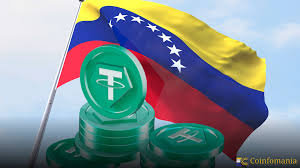
In a move that has sent ripples through global finance and energy markets, Venezuela has turned to a digital dollar to keep its economic engine running. Reports from late 2024 confirm a staggering shift: approximately 80% of the country’s crucial oil revenue is now being settled using the cryptocurrency Tether (USDT). This isn’t just a niche experiment; it’s a fundamental re-engineering of how a nation-state interacts with the global financial system under intense pressure.
For decades, oil has been the lifeblood of Venezuela’s economy. Yet, comprehensive sanctions, particularly those from the United States, have systematically blocked its access to the traditional dollar-denominated banking channels. The result was a strangled economy, unable to easily sell its primary resource or access the proceeds. Faced with this existential challenge, the Venezuelan state and its oil company, PDVSA, have executed a pragmatic, if controversial, pivot toward digital assets.
The Sanctions Siege and the Digital Escape Hatch
To understand the gravity of this shift, we need to look at the constraints Venezuela was under. U.S. sanctions, intensified over recent years, essentially cut off PDVSA from using the global SWIFT banking network for dollar transactions. Traditional banks, fearful of secondary sanctions, steered clear. Consequently, selling oil for dollars became a logistical and financial minefield, crippling government revenue.
This is where Tether enters the picture. Tether (USDT) is a stablecoin, a type of cryptocurrency pegged one-to-one with the U.S. dollar. It operates primarily on blockchain networks like Tron and Ethereum. Its core promise is to combine the stability of the dollar with the borderless, permissionless nature of crypto. For a nation like Venezuela, it presented a potential workaround: a digital dollar that could be transferred globally without necessarily touching a U.S.-sanctioned bank account.
According to a detailed report by Reuters, PDVSA began mandating new customers to hold cryptocurrency in digital wallets as part of their contracts. Furthermore, the state has been actively encouraging existing clients to transition their outstanding invoices to USDT. This systematic approach explains how the 80% figure was reached so swiftly.
The Mechanics of an Oil-for-Crypto Pipeline
So, how does this work in practice? The process represents a significant departure from the norm. Typically, a buyer of Venezuelan oil would transfer U.S. dollars through a network of intermediary banks to an account owned by PDVSA. Now, the flow has been digitized.
A buyer, often an intermediary or trading firm, will purchase USDT on a cryptocurrency exchange. These USDT tokens are then sent to a designated digital wallet controlled by PDVSA or a sanctioned intermediary. Once the transaction is confirmed on the blockchain—a public ledger that verifies the transfer—the oil shipment is authorized. The Venezuelan state then holds these digital dollars, which can be used to pay for imports, converted into other currencies, or held as a treasury asset.
This method offers several immediate, practical advantages. First, transactions can occur 24/7 and are often settled in minutes, far faster than the multi-day process of international bank transfers. Second, while not completely anonymous, the use of blockchain provides a layer of obfuscation that makes tracing the end-use of funds more complex for regulators. Third, it directly bypasses the banks that are enforcing the sanctions compliance.
The Ripple Effects: From Local Markets to Global Policy
The implications of this shift are profound and multi-layered, extending far beyond Venezuela’s borders.
Inside Venezuela, the move has created an unusual symbiosis between the state’s oil apparatus and the local crypto ecosystem. To convert its massive USDT holdings into usable currency for imports and domestic spending, Venezuela likely relies on a network of OTC (over-the-counter) crypto traders and exchanges. This injects digital dollars directly into the local economy, further cementing the use of USDT and other cryptocurrencies in everyday commerce, a trend that had already taken root as citizens sought refuge from hyperinflation in the Bolivar.
On the global stage, Venezuela’s action is a stark case study in “de-dollarization via cryptocurrency.” It demonstrates how digital assets can be leveraged by state actors to circumvent traditional financial gatekeepers. This is being closely watched by other sanctioned nations like Iran and Russia, which are also exploring similar mechanisms. A CoinDesk analysis of the situation notes that this represents a tangible geopolitical use case for crypto that moves beyond speculative investment.
For the United States and global regulators, it presents a formidable challenge. Sanctions policy has long relied on controlling the choke points of the banking system. Blockchain technology inherently disperses those choke points. While the U.S. Treasury can sanction specific wallet addresses, the agile nature of crypto wallets makes this a game of whack-a-mole. This scenario is forcing a urgent rethink of how economic statecraft functions in a digital asset age.
Stability, Risk, and the Shadow of Tether
However, this strategy is fraught with monumental risk. Its foundation rests almost entirely on the stability and legitimacy of Tether. Tether Limited, the company behind USDT, has faced ongoing scrutiny over the reserves that back its tokens. While the company publishes regular attestations, questions have lingered for years about whether it holds sufficient liquid assets to redeem all USDT in circulation during a crisis.
If Tether were to face a “bank run” scenario or regulatory action that shatters confidence in its peg to the dollar, the value of Venezuela’s oil reserves, held digitally, could evaporate overnight. The nation is effectively betting its fiscal survival on the health of a private, offshore cryptocurrency company—a dependency that introduces a new kind of sovereign risk.
Furthermore, this system is not invisible. Blockchain analytics firms like Chainalysis specialize in tracing the flow of funds on public ledgers. While more complex than tracking bank transfers, it is possible for intelligence agencies to map transaction patterns and identify key intermediaries, potentially leading to further secondary sanctions on crypto exchanges or OTC desks that facilitate the trades.
A Glimpse into a Fragmenting Financial Future
Venezuela’s large-scale adoption of USDT for oil settlements is more than a financial hack; it is a bellwether. It signals a future where the global financial system may no longer be a single, unified arena dominated by the dollar and Western banks. Instead, we might see the rise of parallel systems: one traditional and regulated, another digital and decentralized, with nation-states navigating between them based on necessity and opportunity.
This development forces us to reconsider the nature of money, sovereignty, and power in the 21st century. Cryptocurrencies, often dismissed as speculative toys, have demonstrated a potent utility as tools of economic resilience and defiance. The Venezuelan case proves that when a state is pushed to the brink, the architecture of blockchain and stablecoins can provide a scaffold for survival, for better or worse.
The ultimate consequences remain uncertain. Will this allow Venezuela to stabilize and grow its economy outside the sanction regime? Or will it simply introduce a new layer of volatility and dependency? What is clear is that the genie is out of the bottle. The blueprint for using cryptocurrency to settle commodity trades at a state level has been written, and other nations are undoubtedly reading it closely. The intersection of geopolitics and digital assets has moved from theory to reality, and the landscape of global finance will be shaped by its aftershocks for years to come.
Sources:
- Reuters: Venezuela shifts oil sales to USDT amid renewed US sanctions
- CoinDesk: Venezuela’s PDVSA Increases Use of USDT for Oil Exports
- Chainalysis: The 2024 Geography of Cryptocurrency Report (For data on crypto adoption in sanctioned regions)