



















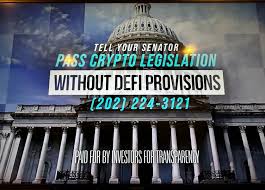
An Anti-DeFi Group In recent weeks, has taken its message to the airwaves of Fox News, transforming complex financial regulation into a direct call to action for millions of viewers. The ads, paid for by a coalition called the “Financial Accountability and Corporate Transparency (FACT) Coalition,” mark a significant escalation in the battle over how—or if—the United States will regulate the burgeoning world of decentralized finance.
What Exactly Are These Ads Asking For?
The legislation in the crosshairs is the much-debated Digital Asset Market Structure Bill, a piece of proposed legislation that has been weaving its way through Congressional committees for months. This bill represents one of the most serious attempts to create a comprehensive regulatory framework for cryptocurrencies in the U.S.
The advertisements focus specifically on provisions within the bill that attempt to define and create regulatory pathways for DeFi protocols. These are blockchain-based applications that allow for lending, borrowing, and trading without traditional intermediaries like banks. The core argument from the FACT Coalition is that these provisions create dangerous loopholes, effectively granting “sanctions relief to crypto criminals, ransomware gangs, and rogue nations.”
Their solution, as blasted across cable TV, is simple: remove the DeFi sections entirely. As one ad states directly, “Tell your senator to protect our national security and strip the DeFi provisions from the crypto bill.”
Who is Behind the “Anti-DeFi” Push?
Understanding the messenger is crucial here. The FACT Coalition is not a grassroots group of concerned citizens; it is a well-established alliance of state, national, and international organizations focused on financial system reform, transparency, and accountability. Its members include groups like the Center for Responsible Lending, Global Financial Integrity, and Public Citizen.
Their perspective is firmly rooted in traditional financial oversight and a deep skepticism of the crypto industry’s claims of innovation. They view the current DeFi ecosystem as a lawless frontier, a haven for money laundering and illicit finance that the proposed bill would inadvertently legitimize and shield.
This perspective was summarized in a public letter the coalition sent to Senate leadership, arguing that the bill’s DeFi provisions “would effectively grant non-compliant DeFi platforms a statutory safe harbor from enforcement” by regulators like the Securities and Exchange Commission (SEC) and the Commodity Futures Trading Commission (CFTC).
The Other Side of the Coin: Why Pro-Crypto Advocates Are Alarmed
For proponents of cryptocurrency and decentralized finance, these ads are a high-stakes alarm bell. They see the campaign not as a principled stand for security, but as a misleading scare tactic that could strangle a nascent technology in its cradle.
Firstly, they argue the ads misrepresent the bill’s intent. The market structure legislation, in their view, doesn’t create loopholes but rather brings DeFi into the light. It attempts to establish clear liability and registration requirements for those who control or significantly influence DeFi protocols—a challenging but necessary step toward compliance.
“The alternative isn’t a safer DeFi ecosystem; it’s an entirely unregulated one that continues to operate in the shadows,” argues Jake Chervinsky, Chief Legal Officer at Variant Fund. “Good-faith legislation is the only path to solving the very illicit finance problems these ads cite.”
Furthermore, the crypto industry sees this as a pivotal moment for U.S. competitiveness. As the European Union rolls out its comprehensive Markets in Crypto-Assets (MiCA) regulations and other jurisdictions create clear rules, the fear is that the U.S. will deter innovation and push developers and companies overseas. A bill that provides clarity, even if imperfect, is seen as vastly preferable to the current state of regulatory uncertainty enforced through aggressive SEC enforcement actions.
The Bigger Picture: A Clash of Philosophies
At its heart, this advertising skirmish is a proxy for a fundamental philosophical clash.
- The Traditionalist View (FACT Coalition): This camp believes the financial system must have identifiable, accountable intermediaries. Their priority is enforcement, sanctionability, and consumer protection through centralized gatekeepers. To them, DeFi’s “permissionless” and pseudonymous nature is a fatal flaw, not a feature.
- The Innovation View (Pro-Crypto Advocates): This camp sees decentralized technology as an inevitable evolution of finance. They argue for regulation that targets clear points of control within software stacks (like front-end developers or governance token holders) rather than an impossible mandate to regulate immutable code itself. Their priority is fostering technological progress within a compliant framework.
This clash makes compromise exceptionally difficult. Stripping DeFi provisions, as the ads demand, doesn’t just leave a gap in the bill—it potentially leaves an entire, multi-billion dollar sector with no legal pathway to exist compliantly in the United States.
What This Means for the Legislative Process
The direct-to-public advertising campaign is a clear attempt to sway political will outside the usual corridors of D.C. lobbying. By framing the issue in stark terms of national security and crime, the coalition aims to generate a wave of constituent pressure that makes senators hesitant to support the bill with the DeFi provisions intact.
This strategy acknowledges the bill’s delicate political position. Cryptocurrency regulation is not a strictly partisan issue; there are proponents and skeptics on both sides of the aisle. Public pressure, especially from a engaged viewership, can be enough to tip the scales toward inaction or significant dilution of the legislation.
The risk, as noted by policy analysts at organizations like the Blockchain Association, is that this leads to a “perfect becoming the enemy of the good.” The quest for a flawless regulatory regime for a complex new technology could result in no regime at all, perpetuating the very risks critics warn about.
Navigating the Path Forward
The path forward for the crypto bill is now more fraught than ever. Lawmakers must weigh:
- The Illicit Finance Concerns: Are the DeFi provisions truly a safe harbor, or do they establish the first real lines of accountability? This requires nuanced technical understanding.
- Innovation and Competitiveness: Does killing these provisions cement U.S. leadership in fintech, or cede it to other global jurisdictions?
- Political Reality: How potent is the public sentiment generated by campaigns like the Fox News ads? In an election year, how will senators balance complex policy with potent messaging?
One potential outcome is a significantly revised bill that tightens liability and compliance requirements for DeFi even further, attempting to bridge the gap between the two camps. Another is a stalemate that delays comprehensive legislation for years.
The Final Word: Your Voice and the Future of Finance
The most telling aspect of the Fox News ads is their core directive: “Contact your senator.” They recognize that this issue, often buried in technical jargon, is ultimately a democratic one. It’s a reminder that the future of financial systems is decided not just by coders and regulators, but by the public and their elected representatives.
Whether you see decentralized finance as a dangerous experiment or the next chapter in economic freedom, this moment underscores that its trajectory is being written now. The ads have thrown down a gauntlet, framing the debate in the most dramatic terms possible. How policymakers, and the public, respond will shape the digital economy for decades to come. The call to action is no longer just in a television ad; it’s in the heart of a defining technological debate.
Sources & Further Reading:
- FACT Coalition Press Release on Ad Campaign
- Text and Summary of the Digital Asset Market Structure Bill
- Blockchain Association Response to Regulatory Challenges
- European Union’s MiCA Regulation Overview
- Public Citizen (FACT Member) Report on DeFi Risks