

















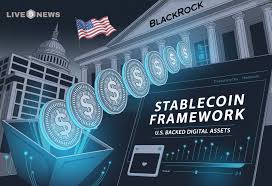
When the world’s largest asset manager speaks, policymakers and investors tend to listen carefully. Recently, BlackRock suggested that stablecoins could significantly challenge government control over currencies, especially in emerging markets. While this statement may sound abstract at first, it actually touches on something deeply human: trust in money itself.
Across Africa, Latin America, Southeast Asia, and parts of Eastern Europe, millions of people already live with unstable currencies. Because of that, alternatives that feel safer, faster, and more predictable are gaining ground. Stablecoins, which are digital tokens usually pegged to strong currencies like the US dollar, are increasingly filling that gap.
Rather than being a distant future scenario, this shift is already underway. And according to BlackRock, the implications could be profound.
Understanding Stablecoins in Simple Terms
Before going further, it helps to clarify what stablecoins really are. Unlike Bitcoin or Ethereum, whose prices swing wildly, stablecoins aim to maintain a steady value. Most are backed by reserves such as cash or government bonds, while others rely on algorithms to keep prices stable.
Because of that design, stablecoins behave more like digital cash than speculative assets. As a result, they are increasingly used for payments, remittances, savings, and even payroll in some regions.
Common examples include USDT (Tether) and USDC (USD Coin). Both are pegged to the US dollar and widely used across crypto platforms and payment rails.
For a deeper explanation of how stablecoins function, Circle provides a clear overview here:
https://www.circle.com/en/usdc
Why Emerging Markets Are Ground Zero
Emerging markets face unique monetary pressures. Inflation, capital controls, weak banking infrastructure, and volatile exchange rates are part of daily life for many citizens. Because of that, people naturally seek alternatives that preserve value.
In countries like Nigeria, Argentina, Turkey, and Venezuela, dollar-denominated stablecoins are already acting as unofficial savings accounts. Instead of holding local currency that loses value, people store wealth in digital dollars accessible through a smartphone.
Moreover, cross-border payments are often slow and expensive. Stablecoins, by contrast, can move value globally within minutes at low cost. Therefore, freelancers, small businesses, and families sending remittances are adopting them rapidly.
The World Bank has repeatedly highlighted the high cost of remittances in developing regions:
https://www.worldbank.org/en/topic/remittances
BlackRock’s Perspective and Why It Carries Weight
BlackRock does not make casual predictions. With trillions of dollars under management, its research teams analyze global risk at a scale few institutions can match. When BlackRock suggests stablecoins may weaken state control over money, it reflects serious observation, not hype.
Larry Fink, BlackRock’s CEO, has previously emphasized the tokenization of finance as a long-term structural shift. Stablecoins fit directly into that vision, acting as bridges between traditional finance and blockchain networks.
Importantly, BlackRock is not arguing that governments will disappear from monetary systems. Instead, it suggests their influence may be diluted as people gain credible alternatives.
A summary of BlackRock’s views on digital assets can be found here:
https://www.blackrock.com/us/individual/insights/bitcoin-and-digital-assets
Monetary Control Under Pressure
Government control over currency usually relies on three tools: issuance, regulation, and trust. Stablecoins challenge all three, especially in fragile economies.
First, issuance shifts away from central banks when people prefer private digital currencies. Second, regulation becomes harder when assets move across borders instantly. Third, trust erodes when citizens believe foreign-pegged digital money is safer than local notes.
As a result, central banks may struggle to enforce capital controls or manage inflation effectively. While this can empower individuals, it also complicates macroeconomic policy.
The International Monetary Fund has discussed these risks extensively:
https://www.imf.org/en/Topics/fintech
The Human Side of Digital Dollars
Beyond economics, this trend has a human story. Consider a small business owner who cannot access foreign currency through official channels. Stablecoins allow them to import goods, pay suppliers, and protect profits from devaluation.
Similarly, migrant workers sending money home can avoid high fees and long delays. Families receive funds almost instantly, often with greater transparency.
Because of these benefits, adoption often spreads through word of mouth rather than marketing. People use what works. And increasingly, stablecoins work better than traditional options.
Governments Are Not Standing Still
While stablecoins pose challenges, governments are responding. Many central banks are exploring or piloting Central Bank Digital Currencies, commonly known as CBDCs. These aim to combine digital efficiency with state control.
China’s digital yuan is the most advanced example, although other countries are experimenting as well. However, CBDCs face trust issues of their own, especially in societies wary of surveillance or political instability.
For context, you may find our earlier discussion on digital currencies useful:
https://example.com/blog/central-bank-digital-currencies
At the same time, regulators in the US and Europe are pushing for clearer stablecoin rules. Rather than banning them outright, many governments now seek oversight and integration.
The Balance Between Innovation and Control
This moment represents a balancing act. On one side, stablecoins offer financial inclusion, efficiency, and resilience. On the other, unchecked adoption could weaken monetary sovereignty.
BlackRock’s warning highlights this tension. It is not a call for panic, but rather a signal that financial power is becoming more distributed. Technology has a habit of shifting control away from centralized institutions, and money is no exception.
As emerging markets continue to digitize, the competition between state-backed money and private digital currencies will intensify.
Implications for Investors and Policymakers
For investors, stablecoins represent both infrastructure and opportunity. They underpin decentralized finance, global payments, and tokenized assets. Ignoring them would mean missing a foundational layer of the future financial system.
For policymakers, the task is more complex. They must protect economic stability while allowing innovation to flourish. Heavy-handed restrictions may drive adoption underground, while thoughtful regulation could harness benefits while managing risks.
The Financial Stability Board offers insight into global regulatory approaches:
https://www.fsb.org/work-of-the-fsb/financial-innovation-and-structural-change/
A Gradual Shift, Not an Overnight Revolution
Despite the headlines, stablecoins will not replace national currencies overnight. Cash, banks, and central banks remain deeply embedded in society. However, gradual shifts often matter more than sudden revolutions.
As trust accumulates, usage expands. As usage expands, influence grows. This is the path BlackRock appears to be highlighting.
In emerging markets especially, where trust in institutions is fragile, alternatives gain traction faster. Stablecoins are not just a technological experiment. They are becoming a practical tool for everyday life.
Closing Reflections on a Changing Monetary Landscape
BlackRock’s prediction should be understood as a reflection of reality already unfolding. Stablecoins are reshaping how value moves, how people save, and how trust in money is formed.
For governments, this is a moment for adaptation. For individuals, it is a moment of expanded choice. And for the global financial system, it marks another step toward a more digitized and decentralized future.
Whether this shift ultimately strengthens or weakens economies will depend on how wisely it is managed. What is clear, however, is that the conversation around money is changing, and stablecoins are now firmly part of that discussion.
Sources:
https://www.bis.org/about/bisih/topics/cbdc.htm
https://cointelegraph.com/explained/what-are-stablecoins
https://www.weforum.org/topics/digital-currency/